
A fresh look at ANet’s five essential dimensions of literacy instruction
What does it actually look like when a student feels confident in their reading and writing? Maybe it’s a fifth grader eagerly finishing a book during lunch, or a ninth grader proudly sharing a personal narrative with their class. These moments of engagement don’t happen by accident—they’re the result of effective, student-centered literacy instruction that recognizes each learner's strengths, identities, and needs.
At ANet, we’ve spent time asking ourselves a big question: What does truly effective literacy instruction look like across all grade levels and contexts? We pored over the latest research from the science of reading, writing, and learning. We looked at frameworks old and new: the five pillars, the simple view of reading, Scarborough’s rope, the active view of reading. And we talked to educators, coaches, and leaders across the country about what’s working (and what’s missing) in real classrooms today.
We’ve seen that strong literacy education doesn’t come from following one framework or set of strategies. It comes from recognizing that reading and writing are dynamic, interconnected processes, and that students thrive when instruction is responsive to their strengths, needs, and identities. That’s why we’ve taken a fresh look at what it really takes to support literacy for all learners. Drawing on the latest research and real-world practice, we identified five dimensions that consistently show up in the most successful classrooms:
Each one is essential, and each is made up of specific instructional practices that help students grow. We will break down what each dimension means, why it matters, and what it looks like in action. If you're looking to deepen your school or district's approach to literacy, reach out to discuss how we can support you in reaching your goals.
Comprehension:
 When Ms. Rivera asked her seventh graders to explain the main idea of the article they’d just read, most paused. A few repeated a sentence from the text. One shrugged. It wasn’t that they hadn’t read; it’s that they weren’t sure how to make sense of it.
Comprehension isn’t just about understanding words; it’s about making meaning.
To do that, students need a strong foundation in vocabulary, knowledge, and an understanding of how texts are structured (Aukerman & Schuldt, 2021; Cervetti & Hiebert, 2015). But that foundation only matters when paired with instruction that gives students tools to process and interact with complex texts in meaningful ways.
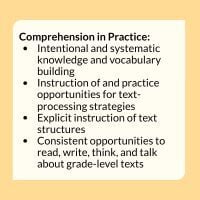 Here’s what that looks like in practice:
🔹 Intentional and systematic knowledge and vocabulary building
Students comprehend more when they already know something about the topic. When we build background knowledge and vocabulary through thoughtfully sequenced content, we make it easier for students to make connections and access the text.
🔹 Instruction of and practice opportunities for text-processing strategies
Strategies like summarizing, predicting, and questioning aren’t one-and-done lessons. They need to be modeled and practiced in the context of real reading, helping students make sense of what they’re reading and stay engaged as they do it.
🔹 Explicit instruction of text structures
Understanding how different types of texts are organized, cause and effect, problem/solution, compare and contrast, gives students a mental map. It helps them anticipate where the text is going and retain what they’ve read.
🔹 Consistent opportunities to read, write, think, and talk about grade-level texts
When students have daily chances to wrestle with rich texts through writing, discussion, and reflection (both independently and with peers), comprehension becomes a shared, active experience (Duke et al., 2021; National Reading Panel, 2000).
When these elements come together, comprehension becomes an active, engaging process, and that shrug in Ms. Rivera’s class turns into a hand raised with a fresh insight.
More to Explore:
- Knowledge Building Matters for Reading Comprehension: Knowledge Matters Podcast
- Are We Teaching Reading Comprehension Part 1 & Part 2 by Tim Shanahan
Foundational Skills:
 When Mr. Gonzales asked his fourth graders to read aloud from their science textbook, he expected a few tricky words. But as students stumbled over “adaptability,” “interdependence,” and “decomposition,” he realized the issue ran deeper. They weren’t just unfamiliar with the content; they were struggling to decode the words themselves. Somewhere along the way, they had missed key pieces of the foundational reading puzzle.
Foundational skills are the building blocks of reading and writing.
They allow students to decode (read) and encode (spell) words accurately and automatically—a must for tackling increasingly complex texts in upper grades. These skills don’t come naturally; they must be taught explicitly and systematically, starting in the early years and evolving as texts and vocabulary become more sophisticated (Ehri, 2020; Duke & Cartwright, 2021).
a819.jpg) Here’s what that looks like in practice:
Here’s what that looks like in practice:
🔹Explicit and systematic instruction of phonics, phonological awareness, and all reading foundation standards and connected language standards.
Reading is not an innate skill. Unlike oral language, it must be taught through a sequence that begins with phonological awareness (rhyming, segmenting syllables, manipulating sounds) and moves into phonics, where students learn how letters and patterns represent sounds. This kind of instruction lays the neurological groundwork for decoding and spelling words accurately.
🔹 Practice opportunities that allow for the application of taught phonics to decode and encode
To master what they’ve learned, students need frequent and varied practice. That means reading words that reflect the phonics patterns they've been taught and spelling them, too. Encoding is often overlooked, but it strengthens decoding and helps students internalize language patterns.
🔹 Opportunities to build fluency
Fluency is the bridge between sounding out words and understanding them. Strategies like choral reading, partner reading, and echo reading help students build speed, accuracy, and expression. And when fluency increases, students can focus more of their mental energy on making meaning, rather than getting stuck on word-by-word decoding.
In Mr. Gonzales’s classroom, foundational skills aren’t just for young readers. They're the key to unlocking complex vocabulary and supporting comprehension across all subjects. When students can read fluently and accurately, they’re able to fully engage with grade-level texts, and the science of ecosystems becomes a lot less intimidating.
More to Explore:
- Teaching Reading is Rocket Science by Louisa Moat
- What Works Clearinghouse: Foundational Skills for Kindergarten-3rd Grade
- What Works Clearinghouse: Providing Reading Intervention for Grades 4-9
- The Reading League: Primary Considerations for Adolescent Literacy
- Empowering Secondary Students with Strategies for Reading - ANet Webinar
-
Coaching to Support Foundational Literacy - ANet Blog
Writing
 In Ms. Saluda’s second-grade classroom, students write every day. One day it’s about brushing their teeth, the next about watching a movie. While her students seem to enjoy the routine, halfway through the year, Ms. Saluda notices something’s off. Their sentences are short and repetitive. Punctuation is hit or miss. There’s little growth and even less structure. She wonders: If they’re writing every day, why aren’t they becoming better writers?
Writing isn’t just about getting words on a page; it’s about thinking clearly and communicating with purpose.
Writing is one of the most cognitively demanding tasks students do. It requires organizing ideas, choosing the right words, applying conventions, and shaping everything for a specific purpose or audience. And yet, in many classrooms, we assign writing but forget to teach it.
0564.jpg) Here’s what that looks like in practice:
Here’s what that looks like in practice:
🔹Explicit instruction of and opportunities to apply the writing process
Writing is a process, not a one-and-done event. Students need to be taught how to plan, draft, revise, edit, and publish. Each stage helps them strengthen not just their writing, but also their reading skills, like understanding sentence structure, author’s craft, and word choice.
🔹Explicit instruction of genre and text structure
Different writing purposes call for different structures. Whether it’s a narrative with a story arc or an opinion piece with claim and evidence, students need tools, like graphic organizers and mentor texts, to internalize how various texts are organized and why it matters.
🔹 Teaching reading and writing as connected skills (not in isolation)
Reading helps students become better writers, and writing deepens comprehension. When taught together, both skills grow. Prioritizing writing alongside reading makes room for students to think more critically, analyze texts more deeply, and express themselves with more power. A 60/40 balance between reading and writing often yields the strongest results.
🔹Explicit instruction of and opportunities to authentically apply grade-level language and literary skills
Grammar and language use shouldn’t be relegated to isolated worksheets. These skills are best learned when students encounter them in texts and apply them in their own writing. Figurative language, rich vocabulary, and sentence variety bring writing to life, and students need to see and try them in meaningful contexts.
Once Ms. Saluda shifted from assigning writing to teaching it, her students’ writing transformed. Their ideas expanded. Their sentences grew more complex. They discovered not just how to write but that they had something worth saying.
More to Explore:
- The Writing Rope: Strands Woven into Skilled Reading by Joan Sedita
- The Science of Reading and Writing Must Become More Fully Integrated by Steve Graham
- Unlocking the “Write” Path - ANet Blog
- Words in Action: How Writing Builds Stronger Readers - ANet Webinar
Active Self-Regulation
 In Mr. Jenkins’ 11th grade ELA class, students regularly engage in close reading. But one day, while analyzing The Tyger by William Blake, he noticed a familiar struggle. Students couldn’t quite name where their comprehension fell apart. When asked what confused them, they shrugged, said things like “I’m just bad at poetry,” or even “I’m not a good reader.” Mr. Jenkins wasn’t sure what was missing—was the poem too hard, the scaffolding too light, or… was it something else?
Active self-regulation is the missing piece for many students.
It’s what allows readers and writers to reflect on their own thinking, recognize when they’re stuck, and choose strategies to get unstuck. It also shapes how students see themselves as learners. Over time, struggling students often internalize negative reading identities, especially if they’ve been pulled out for intervention, stumbled through read-alouds, or rarely experienced success. To disrupt this cycle, we must explicitly teach students to manage their learning and nurture their confidence.
dec7.jpg) Here’s what this looks like in practice:
Here’s what this looks like in practice:
🔹 Timely, actionable, and consistent feedback
Students can’t improve if they don’t know how they’re doing. Feedback, especially when it’s clear, constructive, and regular, helps students notice both strengths and areas for growth. Even better? When students learn to give feedback to each other and reflect on their own work, they begin to see reading and writing as a process, not a fixed identity.
🔹 Strategies that organize thinking during reading and writing
From goal-setting and self-monitoring to using checklists or graphic organizers, students need tools that support their executive functioning. These strategies help them track their progress, identify where they’re stuck, and choose what to do next. With these supports, students learn how to persevere, especially when texts get tough.
🔹 Encouragement to build a literate identity and self-efficacy
How students see themselves as readers and writers directly impacts how hard they try and how long they stick with a task. Encourage students to reflect: What kinds of books do I enjoy? What am I good at as a writer? What do I want to get better at? The more students experience success, voice, and agency in their reading and writing, the stronger their belief in themselves becomes, and that belief is a powerful driver of growth (Duke & Cartwright, 2021; Peterson et al., 2000; Sedita, 2023).
Once Mr. Jenkins introduced tools like a close reading organizer and built in time for students to reflect on their process, everything shifted. Students began to notice when and why they were getting stuck. They started to support one another through tough texts. And slowly, their confidence and their comprehension grew.
More to Explore:
- Approaches for Supporting Adolescents’ Reading Motivation by Webber et al.
- Teacher Practices that Impact Reading Motivation - Blog
- How Do We Teach Executive Function in Reading by Tim Shanahan
Student-Centered Engagement:
 Every time Ms. Chin assigned a new text to her 9th grade class, she was met with groans. Even when she tried paired read-alouds or book clubs, students came to class distracted or didn’t read at all. Discussions fell flat. Engagement was low. She found herself wondering: How do I get them to care about what they’re reading?
Student-centered engagement starts with recognizing students as individuals with voices, perspectives, and lived experiences that matter.
It means choosing texts and designing tasks that reflect students’ backgrounds, interests, and identities, and helping them see reading and writing as ways to understand the world and express themselves within it. When students see their stories and cultures reflected in what they read, or gain insight into the lives of others through texts, they feel more connected, more curious, and more willing to take risks (Ladson-Billings, 1995; Paris, 2012; Sims Bishop, 1990).
8316.jpg) Here’s what that looks like in practice:
Here’s what that looks like in practice:
🔹 Use of student-centered and contextually appropriate texts and tasks
When students read texts that reflect their identities, cultures, and interests, their motivation increases and so does their comprehension. Relevant, meaningful content builds connection, fosters a sense of belonging, and signals that students’ voices and experiences are valued (Aukerman & Schuldt, 2021). Tasks that allow students to explore personal topics, current issues, or community challenges invite deeper engagement.
🔹 Opportunities to think critically about texts and perspectives
Reading should be an invitation to inquiry. Students need to ask: Whose voices are represented here? Whose are missing? Why did the author choose to tell the story this way? These questions build critical thinking and empower students to view texts not as neutral, but as intentional constructions shaped by perspective and power (Woodard et al., 2020).
🔹 Support for using reading and writing to develop and communicate personal perspectives
Literacy is a tool for agency. When students write about what matters to them and respond to texts that challenge or affirm their worldview, they begin to develop a stronger voice and sense of self. Reading and writing become more than school tasks; they become ways to explore identity, express opinions, and participate in conversations that matter (Moll et al., 1992; Paris, 2012).
Once Ms. Chin began choosing texts that acted as both mirrors and windows—books like The House on Mango Street, The Hate U Give, Fahrenheit 451, and Born a Crime—everything changed. Students started coming to class eager to talk, ready to listen, and curious about what others thought. Their writing deepened. They started sharing pieces of their own lives. And little by little, a real classroom community took shape, built through stories, voices, and trust.
More to Explore:
- Mirrors, Windows, and Sliding Glass Doors by Rudine Sims Bishop
- Centering joyful, culturally, and linguistically sustaining instruction in literacy instruction by Kayser et al.
Learn More about Foundational Literacy
We're expert partners to school districts across the US to help educators gain actionable insights and boost instruction. If you're interested in learning more about our foundational literacy expertise, visit our webpage or sign up for our foundational literacy email list!